Beyond traditional road construction
Each day starts with a clear schedule, defining key activities and KPIs to guide and monitor operations efficiently.
Beyond
traditional
road
construction
Introducing
technologies and
processes that
benefit workers,
the environment
and the sector.
-13%
fuel use smarter sites
-13%
GHG
emissions lower impact
+20%
safety perception safer sites
1
Planning the day
Each day starts with a clear schedule, defining key activities and KPIs to guide and monitor operations efficiently.
2
photogrammetry
Drones capture high-resolution images of the site, generating precise data on terrain, structures, and materials.
3
Digital twin mapping
Collected data feeds into a digital twin, a live virtual model of the site, storing and updating all critical environmental and operational details.
4
AI task allocation
AI algorithms in the digital twin prioritise tasks and compute optimal machine routes, minimising distance, time, and emissions.
5
Autonomous earthworks
Autonomous and teleoperated machines follow AI instructions to handle materials, excavate, and redistribute earth efficiently – without human drivers.
6
Human-robot safety
Wearable safety devices and obstacle-avoidance systems keep operators protected while collaborating with autonomous machines and drones.
7
Task iteration
Completed phases are repeated across new locations or tasks, creating a continuous, optimised construction cycle.
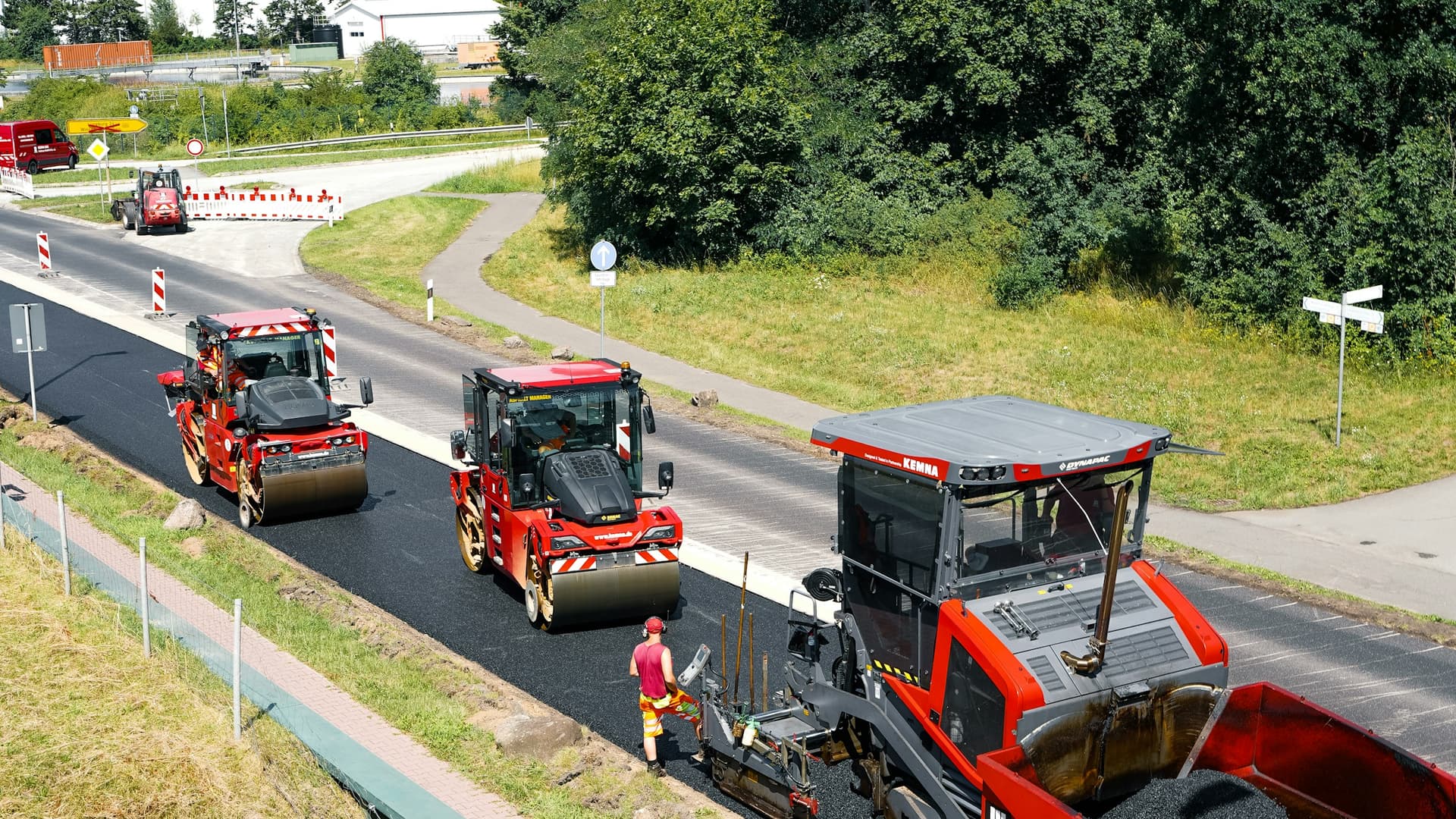
The 7 step workflow was validated on the A24 Highway near L’Aquila (Italy), demonstrating how BEEYONDERS replaces traditional, risky and low-digital construction methods with a seamless human–robot process powered by AI and automation. From terrain scanning to autonomous operations, the system reshapes the entire road-building cycle. But roadworks are only the beginning. BEEYONDERS is applying these and other advanced technologies across several pilots in Europe – each exploring a different construction environment.
Helsinki, Finland
BUILDING CONSTRUCTION
Exoskeletons, smart wearables and UAVs were integrated into daily workflows to support workers, extend physical capabilities and provide continuous data for safer, more efficient operations.
Gijón, Spain
MARITIME CONSTRUCTION
A bio-compatible, 3D-printable mortar and textured, eco-friendly surfaces were tested to optimise caisson construction, reducing waste and encouraging marine biodiversity.
Rotterdam, Netherlands
MARITIME EU–JAPAN
A digital twin of low-vibration press-in piling machines enabled real-time adjustments based on geotechnical data, improving accuracy and understanding of site conditions.
24 Highway, Italy
ROAD MAINTENANCE
Drones and robotic platforms inspected signage and infrastructure, enabling precise monitoring in active traffic conditions and improving worker safety.
León, Spain
TUNNEL CONSTRUCTION
Autonomous and teleoperated ground and aerial vehicles were deployed to assess tunnel conditions and clear debris faster, improving safety and reducing downtime after blasting.