Smart sites, safer lives: how Europe is turning construction safety from reaction into prevention
Europe is transforming construction safety with sensors, AI and connected machinery that prevent accidents before they happen.
ARTICLES
Published On 10 May 2026
Construction remains Europe's deadliest sector, despite decades of regulation. A new generation of interconnected sensors, autonomous machinery and digital platforms can communicate and respond collectively to risks before accidents happen. But experts warn: the technology already works — what's missing is the capital, the skills and the trust to scale it.
On a renovation site in La Garriga, Spain, a construction worker steps near an active crane. Before he even looks up, the sensor in his helmet vibrates — the system has already registered how close he is. Inside the site office, a screen flashes an amber alert: temperatures have crossed a threshold, and the platform recommends pausing outdoor work and increasing water breaks. Nobody shouts. Nothing stops. The site has simply done what construction has rarely managed at scale: see everything happening, all at once, in real time. It is also still the exception.
According to Eurostat, the EU recorded 2.82 million non-fatal workplace accidents in 2023, and 3,298 fatal ones — twelve more than the year before. Nearly one in four of those deaths, 24%, occurred in construction: the single worst share of any sector. Together with transport, manufacturing and agriculture, construction accounts for two-thirds of all fatal accidents at work in the EU. Workers in the sector have historically been three times more likely to die on the job than the average European employee.
Europe’s regulatory framework is, on paper, among the most comprehensive in the world. Good regulations, though, do not automatically translate into safer sites. “Over the past 20 years, workplace accidents and fatalities in European construction have fallen by around 30 to 40%,” says Domenico Campogrande, Director General of the European Construction Industry Federation (FIEC). “But construction sites are constantly changing environments, where multiple contractors and activities take place simultaneously, and workers are regularly exposed to high-risk tasks such as working at height or operating heavy machinery — that is what keeps construction among Europe’s highest-risk industries.” We need rules. “Good ones are good for occupational safety and health — and for business,” says Annick Starren, Senior Research Project Manager at EU-OSHA, the European Agency for Safety and Health at Work, whose research on supporting compliance shows that legislation alone is not enough: enforcement, prevention services and the size of the enterprise all shape whether standards are actually followed on the ground. “Compliance is more than strict regulations,” she points out. “On the one hand, we look at the regulation and inspection perspective, and how it can be improved. On the other hand, we look at what supports compliance in a more proactive way — organisational measures, collaborative measures, or other forms of support.”
This is precisely the gap REN+HOMES set out to address with its Resilient Construction Site (RCS), a digital safety system across small renovation works in La Garriga and three other European countries. “The tools exist — sensors for safety, environmental monitoring, waste tracking — but they all work separately and they don’t talk to each other,” explains Jairis Arleen Alvarez Trujillo, Project Manager for Research and Development at RINA Consulting. “We wanted everything in one place, so that anyone on site can see instantly what is happening.” One of the platform’s specific targets is the blind spot of every crane operator. “He cannot see the entire site unless he turns 360 degrees,” Alvarez Trujillo says. “With our sensor, the operator sees in real time where the workers are, and a vibration alert warns them if they step into a high-risk perimeter.” The system was deliberately built for small renovation sites — historically the least digitalised and least monitored corner of the industry. “But starting from a small site is actually an advantage,” she notes. “If you can digitise a small site, you can replicate it anywhere.”
A complementary approach is being tested by BEEYONDERS, another EU-funded project, on road construction sites in Italy — including a trial on the A24 motorway near L’Aquila. Workers wear connected vests; an autonomous loader, linked through a digital twin and a drone, stops automatically when it detects a worker nearby. “The machine doesn’t just react — it already knows their position before the work begins,” says Fabrizio Federici, the project’s lead for autonomous machinery and wearables at AISCAT Servizi. “That’s the difference between safety as a response and safety as a prerequisite.” By continuously recalculating the loader’s route around obstacles and workers, the Italian demo site also recorded an 11% drop in energy consumption.
So why isn’t this everywhere yet? For Campogrande, the answer has little to do with whether the technology works. “The main barrier is the difficulty of turning isolated pilots into reliable, integrated construction workflows,” he says. Upfront costs are high for the small and medium-sized firms that dominate the sector, and returns are uncertain in a low-margin, project-by-project business. “Construction goes from one project to another,” Campogrande explains. “We need to make sure an innovation can be used across several, not just one — that means improving industrialisation.”
There’s another important issue. Scaling responsibly, Starren argues, also means designing technology around the people who use it. “Do not automate for the sake of modernisation,” she says. “It is key to have end users represented in the design phase, not just the implementation phase. Next to privacy aspects and transparency in how AI is exactly used, the most important element is task autonomy and task variety.” Jobs reshaped by sensors and AI should stay balanced, and accountability should stay where it belongs. “The responsibility for safety remains with the employer,” she stresses. “It cannot be outsourced to an AI-based machine.” She expects the pace of change — AI, robotics, automation — to outrun the institutions meant to govern it. “We might need an agile government that responds to these changes faster,” she says. “Standardisation bodies and inspections also need their skills updated, in an already tight labour market.”
Vibrating helmets and all-seeing screens are not futuristic props. The question, as Campogrande puts it, is what it would take for that to stop being the exception. “Construction needs investments, acceptability by companies and workers, and legal stability and clarity,” he says. Starren adds that “it is important for measures to be accepted by their users, and to be realistic. How many rules do you know in your daily life or at work that are only there for regulation, but are not practical, and sometimes even inhibit good performance?” Until then, the gap between theory and reality will keep being measured in the 3,298 names added to the count each year.
Article by Martino De Mori
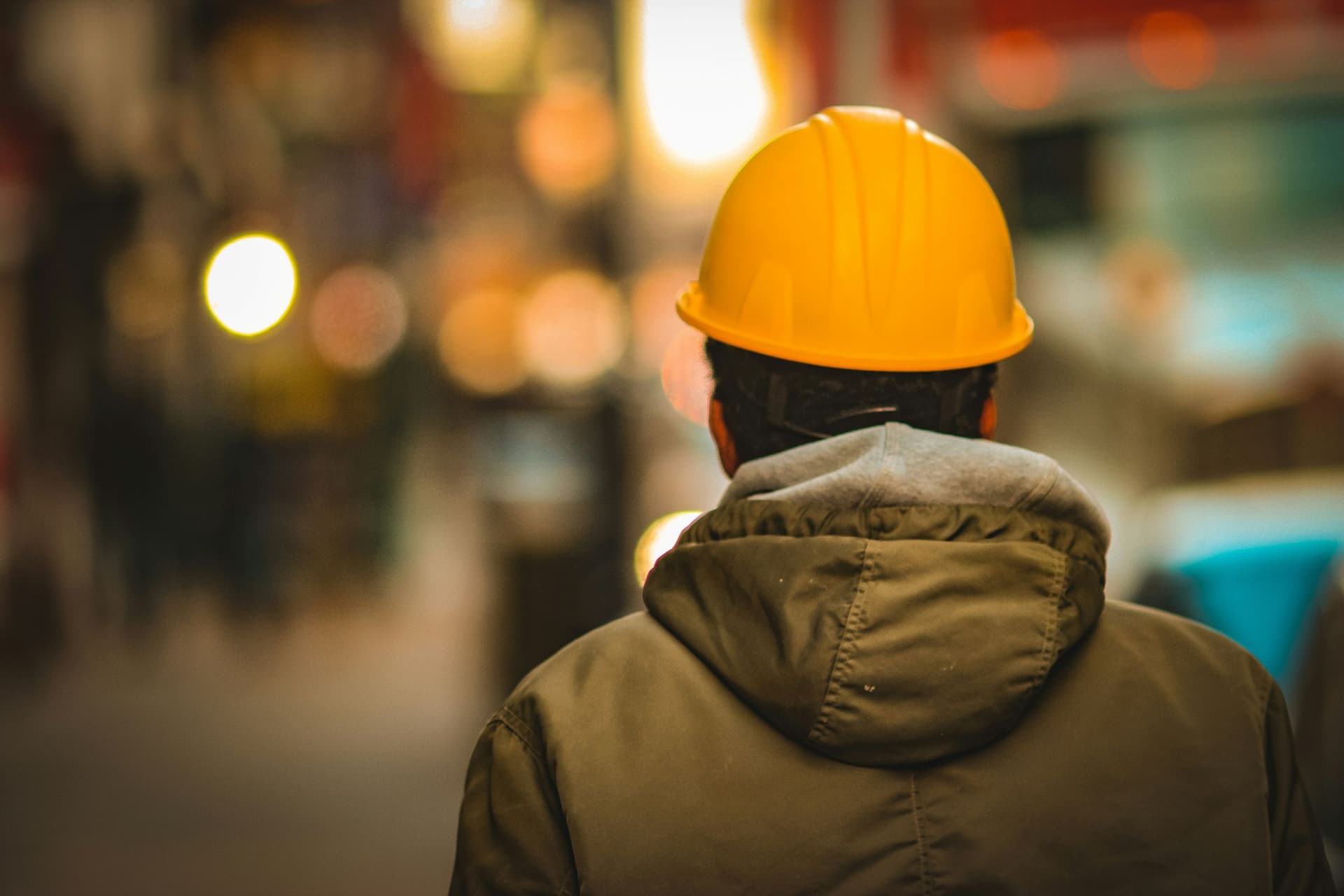
Image courtesy of Jon Tyson, Unsplash